 AmateurRadio.com
Chasse aux NDB dans CLE294

YZS-362 Coral Harbor, NU (ve3gop.com)
Un autre mois s’est écoulé et c’est à nouveau l’heure du CLE. C’est un défi pour tous les nouveaux venus dans l’écoute NDB et le test ultime de votre réception moyenne fréquence capacités. Pouvez-vous relever le défi ?
‘CLE’s sont ‘Co-ordinated L’écoutening Events, et NDB DXers autour le monde concentre son temps d’écoute sur une petite tranche de la NDB spectre.
Avec le nombre de cibles lentement déclassées, les terrains de chasse ont été légèrement élargis … ce mois-ci, la gamme de fréquences est pour les NDB dont les fréquences publiées sont entre 350,0 – 369,9 kHz.
Une bonne cible pour tous les auditeurs NA est la centrale YZS sur 362 kHz, située à Coral Harbour, Nunavut. Écoutez son identifiant CW de bande latérale supérieure sur 362.402 kHz.
Lors du réglage des NDB, mettez votre récepteur en mode CW et écoutez l’identifiant CW du NDB, répété toutes les quelques secondes. Écoutez les identifiants NDB américains environ 1 kHz de plus ou de moins que la fréquence d’émission publiée puisque ces balises sont modulées avec une tonalité de 1 020 Hz environ.
Par exemple, ‘AA’ près de Fargo, ND, transmis sur 365 kHz et son identifiant CW de bande latérale supérieure a été réglé sur 366,025 kHz tandis que sa bande inférieure bande latérale CW ident peut être réglé sur 363,946kHz. Sa tonalité USB était en fait 1025 Hz tandis que sa tonalité LSB était 1054 Hz.
Souvent, une bande latérale sera beaucoup plus forte que l’autre, donc si vous n’entendez pas la première, essayez d’écouter sur l’autre bande latérale.
Les NDB canadiens n’ont normalement qu’une tonalité USB, généralement très proche de 400 Hz. Ils ont également un long tiret (keydown) après l’identifiant CW.
Tous les NDB entendus en Amérique du Nord seront répertoriés dans la base de données RNA (mise à jour quotidiennement) tandis que ceux entendus en Europe peuvent
se trouvent dans la base de données REU. Les balises entendues en dehors de ces régions se trouveront dans Base de données RWW.
Les organisateurs du CLE nous fournissent les informations suivantes :
Bonjour à tous,
Notre 294e événement d’écoute coordonnée est presque là.
CLE se connecte également pour la première fois ? Oui s’il te plaît!
Les journaux courts sont toujours aussi bienvenus que les longs.
Vendredi 28 juillet – Lundi 31 juillet
Horaires : Début et Fin à midi, votre heure LOCALE
350,0 – 369,9 kHz
Veuillez enregistrer tous les NDB que vous pouvez identifier et qui sont répertoriés dans cette plage (cela inclut 350 kHz mais pas 370) ainsi que tous les UNID que vous y rencontrez.
Envoyez votre journal CLE final à ndblist@groups.io, de préférence comme un e-mail en texte brut, pas dans une pièce jointe et – important – avec ‘CLE294’ et ‘FINAL’ dans son titre.
Veuillez afficher les principaux éléments suivants EN PREMIER sur CHAQUE ligne de votre journal :
# La date (par exemple, 2023-07-28) ou simplement le jour (par exemple, 28)
# L’heure en UTC (le jour change à 00:00 UTC).
# kHz – la fréquence nominale publiée de la balise, si vous la connaissez.
# L’identifiant de l’appel.
Les détails facultatifs, tels que l’emplacement et la distance, vont PLUS TARD dans la même ligne.
Veuillez rendre votre journal utile à tout le monde en incluant votre lieu d’écoute, son localisateur Maidenhead à 6 caractères si vous le connaissez, et de brefs détails sur le récepteur et l’antenne(s).
Nous enverrons l’habituel ‘Any More Logs ?’ e-mail vers 19h00 UTC le mardi afin que vous puissiez vérifier que votre journal a été trouvé OK.
Pour être inclus dans les résultats combinés, assurez-vous que votre journal est arrivé sur la liste au plus tard à 08h00 UTC le mercredi 2 août.
Nous espérons obtenir tous les résultats combinés en un jour ou deux.
Vous pouvez trouver des informations complètes sur les CLE actuels et passés sur la page CLE https://www.ndblist.info/cle.htm.
Vous pouvez également trouver vos listes de recherche pertinentes créées à partir de REU/RNA/RWW en visitant https://rxx.classaxe.com/cle.
Bonne écoute
Brian et Joachim
(coordinateurs CLE)
(Rappel : Si vous le souhaitez, vous pouvez utiliser un récepteur à distance pour vos enregistrements, en indiquant son emplacement et son propriétaire – avec leur autorisation si nécessaire.
Un auditeur distant ne peut PAS également utiliser un autre récepteur, qu’il soit local ou distant, pour obtenir d’autres enregistrements pour le même CLE)
Les CLE ont plusieurs objectifs. Ils :
• déterminer, dans le monde entier, quelles balises sont réellement en service et à l’antenne afin que la nouvelle version Base de données en ligne Rxx peut être tenu à jour
• déterminer, dans le monde, quelles balises sont hors service ou sont devenues silencieuses depuis le dernier CLE couvrant cette gamme
• indiquera l’état des conditions de propagation aux différents emplacements des participants
• vous donnera une indication du bon fonctionnement de votre système de réception LF/MF
• proposer aux participants une activité amusante mais stimulante pour perfectionner leurs capacités d’écoute
Les derniers détails peuvent être trouvés sur le Site Web de la liste NDB,
et les résultats mondiaux, pour chaque participant, y seront affichés quelques jours après l’événement.
Le groupe de liste NDB est un endroit formidable pour en savoir plus sur ‘l’art du NDB DXing’ ou pour rencontrer d’autres DXers dans votre région. Il y a beaucoup de bonnes informations disponibles là-bas et les nouveaux membres sont toujours les bienvenus. De plus, vous pouvez suivre les résultats des autres participants au CLE de nuit en nuit car la propagation est toujours un sujet de discussion actif.
Vous n’avez pas besoin d’être membre de la liste NDB pour participer aux CLE et tous les rapports, aussi petits soient-ils, sont d’une grande valeur pour les organisateurs.
Rappelez-vous – Les journaux ‘pour la première fois’ sont toujours les bienvenus !
Les rapports peuvent être envoyés au NDB List Group ou par courrier électronique au coordinateur du CLE, Brian Keyte (G3SIA), dont l’adresse apparaît ci-dessus. Si vous êtes membre du groupe, tous les résultats finaux seront également être envoyé par e-mail et affiché là-bas.
S’il vous plaît … essayez le CLE … puis faites-nous savoir quels NDB peuvent être entendus depuis votre emplacement! Votre rapport peut ensuite être ajouté à la base de données mondiale pour le maintenir à jour.
Amusez-vous bien et bonne chasse !
Steve McDonald, VE7SL, est un contributeur régulier à AmateurRadio.com et écrit de la Colombie-Britannique, Canada. Contactez-le au ve7sl@shaw.ca.
Info de la Source Publié * ICI


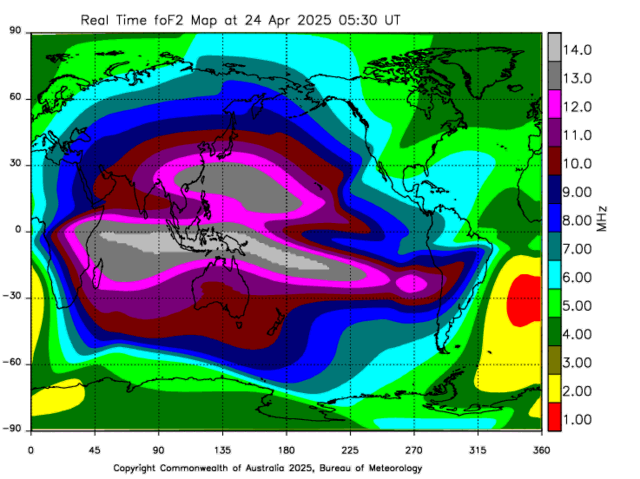

 Interesting is the chart provided by