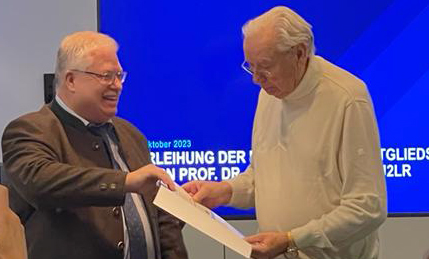
En raison de ses grandes contributions à la radio amateur en Allemagne et à DARC e.V., le Prof. Dr. Ulrich L. Rohde, DJ2LR, a reçu le titre de membre honoraire du DARC le 19 octobre. La nomination a été faite par le président Christian Entsfellner, DL3MBG. Le titre de membre honoraire a été décerné lors d’une cérémonie dans les locaux de Rohde & Schwarz GmbH & Co. KG à Munich.
Christian Entsfellner, DL3MBG (photo de gauche), a salué l’engagement inébranlable et extraordinaire du Prof. Ulrich L. Rohde, DJ2LR, ainsi que son engagement et son soutien généreux et de longue date au club.
Étaient présents des membres de la famille Rohde, des responsables du DARC, des radioamateurs et des employés de Rohde & Schwarz ainsi que d’autres invités.
La soirée était animée par Christian Obersteiner, DL1COM, directeur de division du groupe sportif Funk Company sur le site Rohde & Schwarz de Munich. Au cours de la soirée, il y a eu des conférences intéressantes sur des sujets liés aux radioamateurs. Le premier intervenant était le Prof. Dr. Matthias Jung, DL9MJ, chef du département Formation, Jeunesse et Formation continue (AJW) à la DARC avec le thème « Radioamateur en transition – formation et entrée ».
Le deuxième intervenant était le Dr. Robert Westphal, DJ4FF, qui dans une conférence passionnante a montré les possibilités du « géocaching » dans l’ionosphère en utilisant WSPR et MIMO pour détecter des objets volants sur la base du vol perdu MH370 et, dans l’esprit du professeur Rohde, a appelé au courage de rechercher de nouvelles et des choses inconnues.
Le point culminant de la soirée a été la cérémonie de remise du titre de membre honoraire du DARC par Christian Entsfellner, DL3MBG, au Prof. Ulrich L. Rohde. Sous les applaudissements des personnes présentes, le professeur Rohde a accepté le prix et a remercié la radioamateur pour sa contribution à la formation et au perfectionnement des personnes intéressées par la technologie. Il a également été mentionné que les radioamateurs peuvent constituer un facteur important pour attirer de jeunes talents, notamment pour des entreprises comme Rohde & Schwarz.
Le groupe sportif de la société de radioamateur DLØRUS joue également son rôle dans l’entreprise avec ses nombreux membres techniquement expérimentés. Cela permet aux employés et aux stagiaires ainsi qu’aux personnes intéressées de l’extérieur (par exemple lors de visites d’étudiants de diverses universités d’Allemagne) de s’initier à la technologie radio et ainsi d’échanger des idées et de se former davantage.
Source : Rohde & Schwarz
Info de la Source * ICI