
Oct 30, 2022
[NEWS UPDATE] – TY0RU is now QRT. Antennas and all positions dismantled. 124,000 QSOs made. Now the team move to Togo, where RA1ZZ and R5EC are already QRV from there.
[OCTOBER 26] As the TY0RU DXpedition draws to a close (next stop 5V7RU), very high winds badly damaged various antennas at their QTH. Low band antennas included. See pictures:


[NEWS UPDATE] – TY0RU est désormais QRT. Antennes et toutes les positions démontées. 124 000 QSO réalisés. Maintenant, l’équipe se déplace vers le Togo, où RA1ZZ et R5EC sont déjà QRV à partir de là.
[26 OCTOBRE] Alors que la DXpedition TY0RU tire à sa fin (prochain arrêt 5V7RU), des vents très violents ont gravement endommagé diverses antennes à leur QTH. Antennes à bande basse incluses. Voir les images:
Info de la Source * ICI







 Williamson a photographié le North Polar Hood, un nuage géant de glace d’eau qui se forme



 In 1987 Greenpeace established the ‘World Park Base’ in Antarctica which stayed until 1991
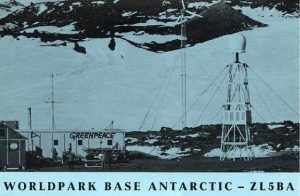 The main Bbase building was constructed in 1987 from prefabricated units, which were designed and manufactured by a German polar construction and engineering company. Between 1988 and 1990 several structures were added. Eventually, basebuildings consisted of an L-shaped main building and a small food storage and emergency building. The main building comprised an accommodation unit housing a common living area, four separate bedrooms, a bathroom, radio room, medical and science room, coat room and a room containing snow melting equipment. A cold porch was also attached. The engine room was housed in the same building, separated from theother facilities by a walkway. A lean-to was used for storage. The short side of the L-shaped building was formed by another unit joined to the main building by a walkway which housed a workshop, science lab, dark room and field equipment store. The latter unit, called the FOS hut, had been acquired from the Footsteps of Scott Expedition which had previously had a base at the site.
  The original base was designed to accommodate four persons. In later years, a workshop and laboratory building and two more bedrooms were prefabricated and added to the original structure as it became apparent that extra space was needed for the wintering teams. These additions were simple to construct andinstall, with minimum excavation necessary. Also installed on the base was amateur radio equipment for contact with Ham radio enthusiasts worldwide, and a Uosat satellite link that was part of a scientific project run in conjunction with the University of Sussex in the United Kingdom.
