
 |
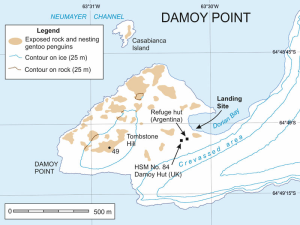 Damoy Point is a headland 900 metres west-northwest of Flag Point, the northern entrance point to the harbour of Port Lockroy, on the western side of Wiencke Island in the Palmer Archipelago of Antarctica. It was discovered and named by the French Antarctic Expedition, 1903–05, under Jean-Baptiste Charcot.
Wiencke Island 64° 49′ 22″ South, 63° 23′ 14″ West, is an island 6 km long and from 3 to 8 km wide, about 67 km2 in area, the southernmost of the major islands of the Palmenr Archipelago Two structures were erected on the shores of Dorian Bay; the Argentinean Refugio Bahia Dorian (WAP ARG-24) in 1957, and a larger building known as the 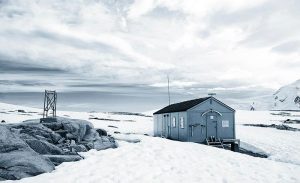 Damoy Hut in 1973 and used for several years as a British summer air facility and transit station for scientific personnel. It was last occupied in 1993, where it served flights to and from a summer-use ice-strip for aircraft used before the sea-ice cleared near Rothera Base. The Damoy Hut (aka Station L) and its ice-strip were closed in 1995: the building is now listed as an Historic Site and Monument and is maintained and administered by the United Kingdom Antarctic Heritage Trust (UKAHT).
Both Argentinean Refugio Bahia Dorian (WAP ARG-24) and Damoy Hut (Station L) WAP GBR-31 have been activated by F5PFP signing respectively LU/FT5YJ and VP8DLM on March 2009. WAP does not have evidence of any other Ham radio activity before that date.
Find out more about Historic Site and Monument No. 84 by watching a short video on Damoy Hut. The site is Antarctica’s only protected historic transit facility and skyway, providing shelter and safe passage for scientists. (Courtesy of UKAHT)
Damoy is a well-preserved Hut containing scientific equipment and other artifacts was. It has been designated a Historic Site or Monument (HSM 84), following a proposal by the United Kingdom to the Antarcti Treaty Consultative Meeting.
For many, this was where they made their first Antarctic landing by ship. “As a first landfall in Antarctica it was hard to beat,” enthuses Steve Garrett, geophysicist. “Surely a candidate for the most beautiful place on Earth.”
The Hut became redundant in 1993 and by 2007 the building was due for demolition. However, it was saved and preserved as “an excellent example of Antarctic logistics and early air operations in Antarctica” helping us to understand the operational challenges of working in Antarctica. It takes its place as Historic Site and Monument No. 84 – one of only 33 buildings, and the sole transit facility, on the continent protected by the Antarctic Treaty.

In 2023, UKART restored the Hut back to its original bright orange. The decision followed paint sampling by our conservation team in 2018 and research by paint scientist and conservator, Phillipa McDonnell, in 2019. The restoration of the original colour scheme improved the legibility of the Hut’s historic function as a transit centre and provides a key hook for the improved interpretation of the site as a whole as well as protecting it from the elements.
The work was undertaken by a small field team of one field guide and two conservation carpenters experienced in conserving historic buildings. They spent nearly four weeks on-site from mid-January, working around challenging weather to strip back the existing paint by hand, prime, and repaint the building to its original bright orange. As with any UKAHT conservation work, the team adhered to strict methodologies to ensure no contamination of the surrounding environment.
.
Thanks and credit to: https://www.ukaht.org/
Damoy Point est un promontoire à 900 mètres à l’ouest-nord-ouest de Flag Point, le point d’entrée nord du port de Port Lockroy, sur le côté ouest de Wiencke
Île dans l’archipel Palmer de l’Antarctique. Il a été découvert et nommé par l’expédition antarctique française, 1903–05, sous Jean-Baptiste Charcot.
Wiencke Island 64° 49′ 22″ Sud, 63° 23′ 14″ Ouest, est une île de 6 km de long et de 3 à 8 km de large, d’environ 67 km2 de superficie, la plus méridionale des grandes
îles de l’archipel de Palmenr Deux structures ont été érigées sur les rives de la baie de Dorian ; le Refugio argentin Bahia Dorian (
WAP ARG-24) en 1957, et un plus grand bâtiment connu sous le nom de
Damoy Hut en 1973 et utilisé pendant plusieurs années comme installation aérienne d’été britannique et station de transit pour le personnel scientifique. Il a été occupé pour la dernière fois en 1993, où il a servi des vols à destination et en provenance d’une bande de glace d’utilisation estivale pour les aéronefs utilisés avant que la glace de mer ne se dégage près de la base de Rothera. La cabane Damoy (alias Station L) et sa piste de glace ont été fermées en 1995 : le bâtiment est maintenant répertorié comme site et monument historiques et est entretenu et administré par le United Kingdom Antarctic Heritage Trust (UKAHT).
À la fois Refugio argentin Bahia Dorian (WAP ARG-24) et Damoy Hut (Station L) WAP GBR-31 ont été activés par la signature F5PFP respectivement < strong>LU/FT5YJ et VP8DLM en mars 2009. WAP n’a aucune preuve d’une autre activité radioamateur avant cette date.
En savoir plus sur le site et monument historique n° 84 en visionnant une courte vidéo sur Damoy Hut. Le site est la seule installation de transit et passerelle historique protégée de l’Antarctique, offrant un abri et un passage sûr aux scientifiques. (Avec l’aimable autorisation de l’UKAHT)
Damoy est une cabane bien conservée contenant du matériel scientifique et d’autres artefacts. Il a été désigné site ou monument historique (HSM 84), à la suite d’une proposition du Royaume-Uni à la réunion consultative sur le traité de l’Antarctique. .
Pour beaucoup, c’est là qu’ils ont effectué leur premier débarquement en Antarctique par bateau. ‘En tant que premier atterrissage en Antarctique, c’était difficile à battre’, s’enthousiasme Steve Garrett, géophysicien. ‘Sûrement un candidat pour le plus bel endroit sur Terre.’
La cabane est devenue superflue en 1993 et en 2007, le bâtiment devait être démoli. Cependant, il a été enregistré et préservé comme ‘un excellent exemple de logistique antarctique et des premières opérations aériennes en Antarctique’ nous aidant à comprendre les défis opérationnels du travail en Antarctique. Il prend sa place en tant que site et monument historiques n° 84 – l’un des 33 bâtiments et la seule installation de transit sur le continent protégé par le Traité sur l’Antarctique.
En 2023, UKART a restauré la cabane dans son orange vif d’origine. La décision fait suite à un échantillonnage de peinture par notre équipe de conservation en 2018 et à des recherches menées par la scientifique et restauratrice de la peinture, Phillipa McDonnell, en 2019. La restauration de la palette de couleurs d’origine a amélioré la lisibilité de la fonction historique de la cabane en tant que transit. centre et fournit un crochet clé pour une meilleure interprétation du site dans son ensemble ainsi que pour le protéger des éléments.
Le travail a été entrepris par une petite équipe de terrain composée d’un guide de terrain et de deux charpentiers de conservation expérimentés dans la conservation de bâtiments historiques. Ils ont passé près de quatre semaines sur place à partir de la mi-janvier, travaillant dans des conditions météorologiques difficiles pour enlever la peinture existante à la main, apprêter et repeindre le bâtiment dans son orange vif d’origine. Comme pour tout travail de conservation de l’UKAHT, l’équipe a adhéré à des méthodologies strictes pour éviter toute contamination de l’environnement environnant.
.
Merci et crédit à : https://www.ukaht.org/
Info de la Source Publié * ICI
